
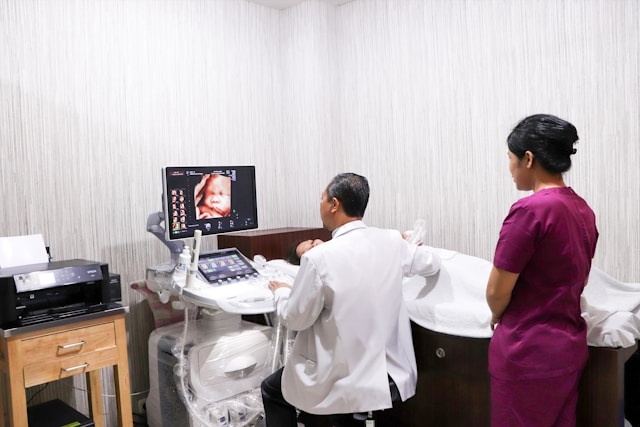
Pregnancy comes with many firsts, and the first glimpse of your baby on ultrasound is one you may never forget. It is exciting, and it is also an important medical check that helps your care team confirm milestones, track growth, and support a healthy pregnancy.
At OBGYN Specialists of Columbus, most ultrasounds are performed right in our office by experienced clinicians who explain what you are seeing in real time. Our goal is to make each scan clear, comfortable, and meaningful, with compassionate guidance at every step.
Below is a simple guide to when ultrasounds typically happen, why they are ordered, what you can expect during a scan, and how results are shared.
Why prenatal ultrasounds matter
Ultrasound uses sound waves to create images of your uterus, placenta, and baby. There is no radiation exposure. Each scan has a specific purpose, from confirming dates to checking anatomy and well-being later in pregnancy. Your provider will recommend the right timing for you based on your medical history and how your pregnancy progresses.
The usual ultrasound timeline
Every pregnancy is unique, but many patients will experience some or all of the following imaging milestones:
- Early dating scan, about 7 to 10 weeks: Confirms an intrauterine pregnancy, estimates your due date, and assesses early cardiac activity. This scan is often part of your first prenatal visit at our practice.
- Nuchal translucency (NT) ultrasound, around 11 to 13 weeks and 6 days: Measures fluid behind the baby’s neck and checks early anatomy. When paired with blood screening, it helps estimate the chance of certain chromosomal conditions. Your provider will discuss whether this screening is right for you.
- Anatomy scan, typically 18 to 22 weeks: A detailed head-to-toe assessment that looks at the brain, heart, spine, face, abdominal organs, limbs, placenta location, and amniotic fluid. This is the most comprehensive routine ultrasound during pregnancy.
- Growth and well-being scans, timing varies: Some pregnancies benefit from additional imaging in the third trimester to monitor growth, fluid levels, or placenta position, or to follow maternal conditions. If indicated, your provider may order a biophysical profile (BPP), which combines ultrasound observations with fetal heart rate testing to assess overall well-being.
How many ultrasounds you will have can vary. Many low-risk pregnancies have at least two: the early dating scan and the mid-pregnancy anatomy scan. Additional scans are individualized, and your clinician will explain the reasons and timing if more are recommended.
What to expect during your visit
Most obstetric ultrasounds are performed with a small handheld device (transducer) moved over your abdomen with warm gel. Early in pregnancy, a transvaginal ultrasound may be used to obtain clearer images; this is a thin, wand-like probe inserted a short distance into the vagina. It should not be painful, and you can pause any time if you need a break.
Appointments are typically 20 to 45 minutes, depending on the type of scan and your baby’s position. Our team talks you through what we are assessing and points out key features when possible. If your baby is snuggled into a position that makes imaging difficult, we may ask you to change position or return for a brief follow-up to complete the views. Your comfort comes first.
Do you need a full bladder?
It depends on the timing. For very early abdominal ultrasounds, a comfortably full bladder can help lift the uterus into better view. If we need this, we will let you know when scheduling and recommend drinking water ahead of time. For most mid to late pregnancy scans, a full bladder is not required. If a transvaginal ultrasound is planned, you will usually be asked to empty your bladder before the exam.
When can the baby’s gender be seen?
Fetal sex may be visible on ultrasound as early as 16 weeks, though clarity typically improves by the 18 to 22 week anatomy scan. Visualization can be limited by your baby’s position, fluid levels, and other factors. If determining sex is important to you, let your sonographer know so we can try to obtain the best possible views. If the angle is not ideal, your provider can discuss options for a short recheck when appropriate.
How and when results are discussed
In most cases, your clinician will review preliminary findings with you right after the scan or at the same visit. Some measurements and images are also reviewed by your provider after you leave. If anything needs follow-up, we will contact you and arrange next steps. For many patients, that means leaving with reassurance that growth and anatomy look as expected. If something is unclear or incomplete, we will explain why and how we plan to get the answers you need.
Safety, comfort, and your in-office experience
Our care philosophy centers on partnership, informed consent, and your comfort. Ultrasounds are performed in-office so your care stays coordinated and personal. You are welcome to bring a support person if space allows. Photos are often available, and we will let you know if our equipment captured keepsake images during your scan.
If you live in the Chattahoochee Valley and are exploring your options for prenatal care, learn more about our Columbus obstetric services and what to expect during prenatal care with our team. For families curious about keepsake views later in pregnancy, ask us about our clinical imaging and how it compares with 3D and 4D ultrasound options.
FAQs
- At what weeks are ultrasounds typically done? Most patients have a dating scan around 7 to 10 weeks, an NT scan between 11 and 13 weeks and 6 days if chosen, and an anatomy scan at 18 to 22 weeks. Growth or biophysical scans may be added later if clinically indicated.
- How many ultrasounds will I have? Many low-risk pregnancies include two to three scans. Your total number can vary based on your health history and what we see at each step.
- Do I need a full bladder? Early abdominal scans sometimes benefit from a comfortably full bladder. Mid to late pregnancy scans usually do not. We will give you specific instructions when scheduling.
- Can an ultrasound show the baby’s gender? Often yes by 18 to 22 weeks, sometimes earlier. Visibility depends on fetal position and other factors.
- Will I get my results right away? In most cases, your provider reviews findings with you during or soon after your visit. If additional review or follow-up is needed, we will contact you promptly to discuss next steps.
When more monitoring is helpful
Some pregnancies benefit from closer imaging follow-up. Reasons can include a history of high blood pressure, diabetes, concerns about growth, placenta position, multiples, or other maternal and fetal conditions. If this applies to you, we will explain what we are watching, how often we recommend scans, and how the information guides your care. The goal is simple, to keep you and your baby as healthy as possible.
Preparing for your scan
- Wear a two-piece outfit so your abdomen is easy to access.
- Arrive a few minutes early to check in and update medications or allergies.
- Bring your questions. We are here to answer them.
- If asked to hydrate beforehand, sip water steadily in the hour before your appointment rather than all at once.
Compassionate care, close to home
From your first positive test to the moment you meet your baby, you deserve attentive care and clear information. OBGYN Specialists of Columbus provides comprehensive prenatal support, including in-office ultrasounds, education, and delivery planning tailored to you. If you are ready to begin or transfer care, explore our Columbus prenatal care and OBGYN team in Columbus to schedule a visit. We look forward to caring for you and your growing family.
In summary, ultrasounds are safe, informative tools that guide your prenatal care at key points, usually early for dating, at 11 to 13 weeks for NT if chosen, at 18 to 22 weeks for anatomy, and later if needed for growth and well-being. You will know when a full bladder helps, when sex can often be seen, and how results are shared. Most importantly, you will have a supportive team walking through each step with you.
 706.324.0471
 admin@obgynsoc.com

